Rwanda

Thirty years ago this month, the people of Rwanda experienced a tragedy my western American mind could not fathom. Over the course of ninety days or so, members of the Tutsi minority ethnic group, as well as some moderate Hutus, were killed by armed Hutu militias. Neighbors killed neighbors. Family members turned on other members of their family. Even ministers, gathering their flock into the Church, betrayed the faithful and saved themselves.

By the time it was over, nearly a million people were dead. Most of the world, including the US, just watched.

Because justice was such a slow process – and in an attempt to heal the communities – the Gacaca courts were established. These trials, to put it simply, allowed those who were willing to admit their part in the killings a chance for early release. There were conditions: if they showed where bodies were buried, and if the communities were willing to take them back, people who had participated in the atrocities could be released from jail to return home. Nearly two million trials were held and though the system was plagued with problems, nearly a million people were released.

Ten years after the genocide and eight years before the Gacaca courts were shut down, I was in Rwanda with a small group from Catholic Relief Services. We were there to witness, among other things, what micro-finance programs had done to reestablish small businesses, restore dignity to the people – especially women – in the years after the genocide. We were also there to pray with the people, visit the mass graves, and talk about what the country had been through. It was then, and likely will always be, one of the great honors of my life. It was also deeply disturbing.

After several days in the city of Kigali, the group was split up and my friend, Anthony, and I traveled to the far western part of the country to the Diocese of Cyangugu. There, we visited parishes, prayed with the residence, played soccer with the students, and visited refugee camps (the people fleeing Congo). Mostly, we listened to their stories.

It has been twenty years since our visit, but several conversations remain in my mind as though they occurred yesterday. On one particular morning, we were sitting with less than a dozen people, listening to their stories of the days of the genocide. We heard how people hid from neighbors. They spoke about never finding the bodies of loved ones. They spoke of darkness, fear, and what it was like to run for your life.

Then, unexpectedly, one man introduced himself and said he had participated in the genocide. He had killed many people. He had been jailed. Then, through the Gacaca courts, he had admitted to what he had done, revealed the mass grave to his town, and been freed – welcomed home, returned to his family, and was now sitting across from me.

I think my shock surprised them. My limited capacity to love could not comprehend how this person was free. He had killed people. We had been to that mass grave. I vaguely remember saying something, more to myself than anyone in the room, “How does that happen?”

The elderly woman sitting next to me took my hand. I can still feel her small, wrinkled fingers on top of mine. Through our interpreter she explained.

“If we do not forgive, hatred wins.”

That was it. That was her explanation. For her, it was just that simple. Either you forgive or you rot inside. Suddenly, the loss I had experienced in my own life – losing grandparents, a brother, friends – my own struggles in life – all rearranged in my head. My loss was nothing compared to theirs. My life was easy compared to theirs. My whole world needed a reboot. All these years, I had believed forgiveness was something you gave to others, but this woman, still holding my hand, reminded me that, often, forgiveness is something you give yourself.

The alternative is you can let hatred win. You can let yourself be eaten from the inside out with the anger, disillusionment, frustration, and lament. At the cross, Jesus loves hatred to death. His “yes” to God gives hatred a space to die. This man who is not owed forgiveness, forgives others. He sees what is happening around him and knows the world needs saving. He knows, at his core, if we do not forgive, hatred wins.

I think about the people of Rwanda all the time. I am still challenged by the words of that old lady and I am still struggling to forgive as she had, as her community had. But each day, I feel like I get a little bit closer.

This week, let us strive to forgive those little things around us. May our perspective be rearranged so we understand injuries as inconveniences and people who irritate us as opportunities to love other people more sincerely.

Most of all, may we love the hatred around us to death so that new life can begin again.

The List

There is a card in my wallet that tells a story. Many of you have heard the story and some may even have lists of your own. The list, the card, battered and torn, started, as all good stories do, with a teacher who made a difference.

It was my junior year in high school and Sr. Judy Eby, RSM asked us to reflect on the reading from Mark’s Gospel that we will proclaim at Mass on Friday morning this week. You’ve heard the story before: there are crowds gathered around Jesus and so some guys carry a paralytic, drop him through the roof, and in front of Jesus.

After we read the story in Sr. Judy’s class, she wheeled in that big glorious television that promised a break from the text and we all move our seats so we could see it. It was a scene of Franco Zeffirelli’s 1977 masterpiece, Jesus of Nazareth. The story unfolds sort of like like it does in Mark’s (and Luke’s) Gospel: the crowds have gathered and there is no room for the men to bring their friend to Jesus. He cannot walk so they carry him over the wall, through the thatched roof, and place him before the Teacher.

You know what happens next. The man is told his sins are forgiven. The crowd goes nuts. “Only God can forgive sins,” they reproach Jesus. Putting yourself on the same plane as God is only going to cause trouble. To this, we get a classic Jesus response: “Which is easier, to say, ‘Your sins are forgiven,’ or to say, ‘Rise and walk’?”

Think about it. Surely forgiving sins is easier. But how can someone who is not harmed be the one to forgive sins? To show the crowd what he’s really capable of, he tells the man to get up, pick up his mat, and go home. The man obliges. The crowd goes nuts for a new reason and everyone learns an important lesson.

But back to the card in my wallet.

We wrap up the reading, the watching, and the discussion about the friends who carried the stretcher, and Sr. Judy hands us all an index card. “Now,” she tells us, “write down the names of those who carry you to Christ.”

I have repeated that exercise with youth and adults alike for years. Like Sr. Judy, I challenge people to think of those who, when we are paralyzed with fear, sinfulness, guilt, and selfishness, carry us to Christ. When you cannot move, who lifts you up? When you are sick or alone or unhappy or in serious need of a friend, who do you call?

I have edited my list throughout the years. Friends come and go. People die. But my list has been there since that spring day in 1987. I have moved it from wallet to wallet. It’s a thirty-year-old ratty piece of paper that I carry with me everywhere.  On more than one occasion, the list has saved my life, my soul, my sanity.

Go ahead, take out a piece of paper.

Who is on your list?

Come, Holy Spirit

Come, Holy Spirit…

Fill our mouths with language that is kind instead of hateful.

Fill our homes with love instead of greed.

Fill our schools with knowledge instead of guns.

Fill the halls of power with authenticity instead of dishonesty.

Fill our skies with birds instead of weapons.

And fill our world with peace.

Give our children the wisdom to see that they are loved – and lovable.

Give our parents the courage to say, “no” to that which is harmful to children.

Give our leaders the strength to speak truth to power.

Give us all the fortitude to bring peace to our workplace and homes.

Wash us clean, Holy Spirit, that we may begin again, renewed, resolving to work for what is right, what is holy, what is just, and what is good.

Most of all, Holy Spirit, open our hardened hearts to receive your Spirit. Open our closed minds to receive your wisdom. Open our mouths only to proclaim praise to the Triune God, the giver all of gifts.

Amen.

Come Holy Spirit

Come, Holy Spirit, grant me patience. Today. Now.

Come, Holy Spirit, grant me wisdom to follow the rules, row in the right direction, work together for the common good.

Come, Holy Spirit, shower me with the knowledge that you are right and just, even when I think I have all the answers.

Come, Holy Spirit, grant me the courage to speak with love.

Come, Holy Spirit, give me the understanding to see clearly what is before me and the right judgment to know when to be quiet, when to speak loudly, when to serve, and when to depart in peace.

Come, Holy Spirit, give me the wonder and the awe that sees that you are here – and there, wherever I may go.

Come, Holy Spirit, help me to pray. Help me to remember that you are in my presence, though I may feel far from yours. Help me to know that you long for me more than I could ever long for you.

Help me, Holy Spirit,  to forgive – and grant me the grace to forget.

Guide me, Holy Spirit, to fill the world with your Hope, your Charity, and your Presence.

Lead me, Holy Spirit, to communicate the Good News you bring to those I meet, where I work, where I pray, and where I live.

Come, Holy Spirit, fill us with your gifts. Teach us, help us, lead us by your grace, to complete the work you started so long ago. Counsel me, guide me, move me, and improve me. Send me out into the world on the breath of the Risen Lord.

Amen.

Born Blind

In Sunday’s Gospel, we hear the story of the man born blind. He finds Jesus and is healed.

It would be easy to think of this man in light of all those we know who are also blind: those who only see color when they look at others, those who only see religious practices that differ from their own, those who fail to see others in need, in pain, in darkness.

But for whatever reason, the Gospel made me think of all the things I still do not see. Though these things are ever present, I am blind. Though there are those around me who are light, I still somehow remain in darkness.

This week, I will wash my eyes and pray for sight.

To see the child whose needs are greater than my own.

To see and hear the coworker who just wants to talk.

To see the friend who has advice to share.

To see the spouse who is tired.

To see the person in need at the corner.

To see the reflection of Christ in the mirror.

To see the leader who knows more than I do.

To see the opportunities for new life around me.

Master, I want to see.

O God of Light, wash away the darkness.

Liftoff

This Wednesday the Diocese of Bridgeport will give birth to The Leadership Institute. I get to be the midwife.

So much has changed in a year: new job, new house, new diocese, new parish, new friends, new challenges. It is a great blessing to be working in a diocese that values vision, direction, and creativity. Our leaders encourage people to look beyond the proverbial box and into what is possible for ministry, for the faithful, and for everything in between. We are coworkers in the Vineyard in every sense of the word.

My role as the founding director of the Institute means that I am the one who has been fortunate to bring the work that we have been able to do thus far to fruition. We are not as far as I would like, delayed by finding the right technology and making sure all the pieces of the puzzle fit. Still, it has been an amazing year (almost a year since I began) and the plans for what is next have me getting to work early and staying late. It is an exciting time to be a part of ministry here in Fairfield County.

On Wednesday night we will gather in prayer to launch the Institute. Shortly thereafter, learning modules will go online, workshops will be announced, and formation will commence. But first, we will reflect on Sirach 6, which encourages those who encounter the last half of the chapter to search for wisdom through patience, persistence, docility, and perseverance, knowing that we can search for wisdom all we want, but must remember that only God grants it.

We will also reflect on 1 Corinthians 15, one of my favorite Pauline passages. “…by the grace of God I am what I am, and his grace to me has not been ineffective…” Indeed, as I look back over all that has changed, all that endured before the changes happened, all those I left – eagerly and begrudgingly – all that I am and all that I have been – has made me who I am today.

Join me, please, in praying our official Institute prayer in thanksgiving for who we are as children of God, and for the great success of all the Institute hopes to accomplish.

God of Wisdom and Love,
You have called us to be missionary disciples of your Son,
and to use our gifts to build up His Body, the Church.
Empower us to follow the example of the twelve apostles
and to spread the Good News to the ends of the earth.

May we Encounter You in all our studies,
May our Formation be guided by Your Holy Spirit,
And may the Discipleship in which we share transform us
So that our ministry may renew the world
One person at a time.
We ask this through Christ our Lord.
Amen.


To learn more about the Institute, please visit www.formationreimagined.org

Needs

I was really afraid I would have to write about politics this morning. Everyone is still talking about the election. As Fr. John said at Mass on Sunday, it happens every year: If you backed the winner, you are elated. If you backed the loser, you can’t understand how everyone else could be so thick headed. Still, the Republic stands.

But this year seemed different. The campaign was uglier than usual, filled with fear-mongering, comments we would never repeat to our children, and promises that, if carried out, seemed just as un-American as they are un-Christian. A generation used to getting its way has taken to the streets. Up is down. Apples are oranges. Politics has become the ultimate reality show and the person who could out punch, out last, out tweet, and out manipulate their opponent has won.

But I don’t want to write about politics. So I look to this morning’s Gospel reading for hope.

There it is, Luke’s version of the blind man on the side of the road. “What do you want me to do for you?” Jesus asks.

The man replied, “Please, I want to see.”

This reading always makes me chuckle. The man was blind. The people on the side of the streets knew it (they had to tell him what all the fuss along the road was about). My guess is the townspeople knew it. He certainly knew he was blind. And Jesus likely knew too, if not as he entered the town, surely Jesus was smart enough as others led the man to him to realize the man was blind.

Still, he asked the question, “What do you want me to do for you?”

I always imagined Peter, who struggled to understand so many things, slapping himself on the forehead at the question and then leaning in to whisper to Jesus, “Dude, he’s blind. You really had to ask?”

But yes, Jesus has to ask. Because the question demands an answer – just as much now as then.

What do you need? What do you want? What can the Master Teacher do for you today? How can I heal you? How can I serve you? What do you want me to do for you?

The story is not about a man born blind. The story is about a Messiah who wants to know our needs.

So name your needs. Tell Jesus what’s bothering you. Pray your story, your frustrations, your fears, and your hopes.

Then let Jesus give you the ability to see and enjoy the unmerited grace that comes from simply naming your needs.


Remember

I remember, like all of you, where I was on that Tuesday morning fifteen years ago. I remember watching the events unfold, the emails from around the globe as family checked on family, the phone calls from Brazil as messages were relayed to and from my uncle who lived there to family living in Tennessee because calling Brazil that morning was possible; calling family in New York was not.

But more than anything, I remember watching the news, the coverage, the stories, and the sadness. I have always been fascinated by the news, long before I studied journalism in college. In those days that followed I was pinned to the television. I could not watch enough. I remember how, in those early hours, the people called the place “Ground Hero” in memory of all those brave men and women who ran into the fire. They ran into the fire.

Soon the media would rename it Ground Zero, the epicenter, even though for some families, the epicenter was the Pentagon or a field in Pennsylvania. The moniker stuck, like it often does when people repeat it again and again.

I remember, in the midst of the chaos, the cameras turned to the families when the families started to gather because their loved ones had not come home from work. The pictures of the missing filled the screen as commercials were abandoned and some channels were too overcome with grief to broadcast at all. I remember the pictures. The men and women holding posters with photos of their parents, brothers, sisters, lovers, and friends adhered hastily to anything they could find. Just to be able to stand with a photo was enough. There were no words.

Then, because journalists are human and most humans are afraid of silence, the reporter thrust a microphone towards a woman and quietly said, “Tell us about your husband.”

“Every time he walked into the room,” she replied, “He took my breath away.”

Fifteen years later, it still gives me chills.

May our God, who is beyond all understanding, give you peace this week.

May we look upon those we love with the face of Jesus.

May we practice patience.

May we be people of peace.

And may we, in the silence of our hearts, pause for moment to look at the bright blue September sky.

To remember to give thanks.

For a faithful God who takes our breath away.

Again and again and again.


A Prayer for the First Week of School

Master and Teacher,

Bless the students who will have trouble settling down this week, whose minds are still at the beach or at grandma’s swimming pool, or the amusement park or soccer camp.

Bless those who sit nervously in class: those who are new in school and those who never read anything over the summer and know a test is coming.

Bless those who will struggle, those who will succeed, and those who get lost in the crowd.

Bless the new friendships that will begin on day one and bless those cherished friendships that will be renewed.

Bless them all with compassion, that they may root for the underdog, celebrate those who accomplish much, and pray fervently for each other.

Bless them with an environment free from bullying, needless competition, and petty jealousy.

Help them, Lord, to fall in love with learning.

Bless the parents of these students, their first teachers in the ways of faith. Give them patience when the homework takes too long, give them courage to understand that their children are not perfect, and give them the courage to discipline with love. May they abdicate less and partner more.

We beg you, Lord, to bring these children safely home at the end of the day, the week, or the semester. Keep them free from violence – at home and at school – on the bus and on the streets – and guide them home to the waiting arms of those who loved them first.

Finally, Lord, we pray in the thanksgiving for the men and women who have already been hard at work straightening desks, taping names to cubbies, painting lockers, planning classes cleaning rooms, decorating bulletin boards, hanging posters, and studying test scores. Bless these servants with peace, patience, persistence, and your Spirit, that they may be Your presence to our young people, Your hands, and Your voice.

We make this prayer through Christ our Lord: teacher, servant, and source of all hope.

Amen.


Three Steps

Looking ahead to this week’s Gospel readings had me searching through the archives of this blog when it appeared in another form. I love the reading about walking on water (Mt 14). It puts me in the mood for impossible things. So here is the earlier reflection with some updates:

I can imagine the storm, the darkness, and the fear. I can imagine what it must have been like to feel alone, wondering if anyone would help as the waves got bigger and I feel smaller. It’s like that feeling you get when you are in bed and you swear you hear a noise…and you freeze. It gives me chills just thinking about it.

Then Jesus comes along – wait, is that Jesus? Sometimes I don’t recognize Him. Is He in a boat? Or are we that close to shore? No, wait. He is walking on the water. Holy cow. It’s like He is stepping on stones as he comes closer and closer.

Then Peter, that rock, that steady but sometimes dim witted leader, says something to Jesus and Jesus responds. What are they talking about? Then Pete hops out of the boat and starts walking on the water too. This is incredible. I forget about the storm. I forget about my fear. I am watching the impossible; or rather two men doing the impossible.

Suddenly Peter begins sinking. What did he say? He must have called out, because Jesus reached after him and brought him to safety, but he had that look on his face, Jesus did…that look that says, “Why do you persist in your unbelief? Why are you so hard hearted?” I’ve seen that look before.

Later Jesus is asleep and we are giving Peter a hard time. He did, after all, lose faith and start to sink. If it weren’t for Jesus he probably would have drowned.

Peter takes it all in stride. He just listens for a bit and then starts to smile. It’s a smile that comes from knowing the Truth.

“Three steps,” he say. We are silent.

“Three steps,” he repeats.

“How many steps did you take on the water? I may have started sinking, but I took three more steps than the rest of you…”

He is right. We are well rebuked.

Jesus will be all around me this week and in many cases, I probably won’t recognize Him. I am often distracted by life.

“Three steps,” I say to myself.

How many steps will you take this week?


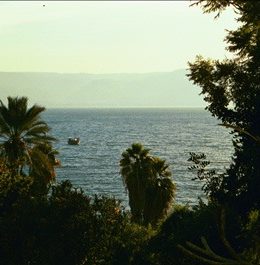
Photo: Sea of Galilee, taken on visit with CRS in 2000