
Plans

So as I look at the week ahead and review my to do lists, what we will cook for dinner, what still needs to be done around the house, and what will occupy my time at work and at home, I look to this morning’s Gospel for direction.

And, as usual, Luke interrupts my thoughts with a challenge. We have all been the man in the story from this morning’s Gospel reading. He has a wonderful harvest and makes plans to build bigger barns. But then something comes along and ruins those plans – or in his case, his own death gets in the way of the new barns he wanted to build.

In the story, the man is chastised not because he plans but because his plans do not include God. “Here is what I will do…I shall tear down…I shall build… I shall store…then I shall say to myself…”

He keeps his wealth instead of sharing it. He plans to take care of himself and forgets those in need around him. He looks out for number one and avoids eye contact with the man or woman standing next to him, those standing on the corner, those sitting across from him or suffering across the world.

It’s a story to which we can all relate.

But, as the poet reminds us, “No man is an island…”

So I go back over my schedule for the week. When is time for prayer? When will I make sure I am present to others? When will I go out of my way to share the harvest, limited though it may be at times, with others?

Planning is good. Plans that include God are better.


Healed

After last night’s televised freak show, I am tempted to reflect on the demise of American democracy, but thankfully, I am distracted by the story in Sunday’s Gospel.

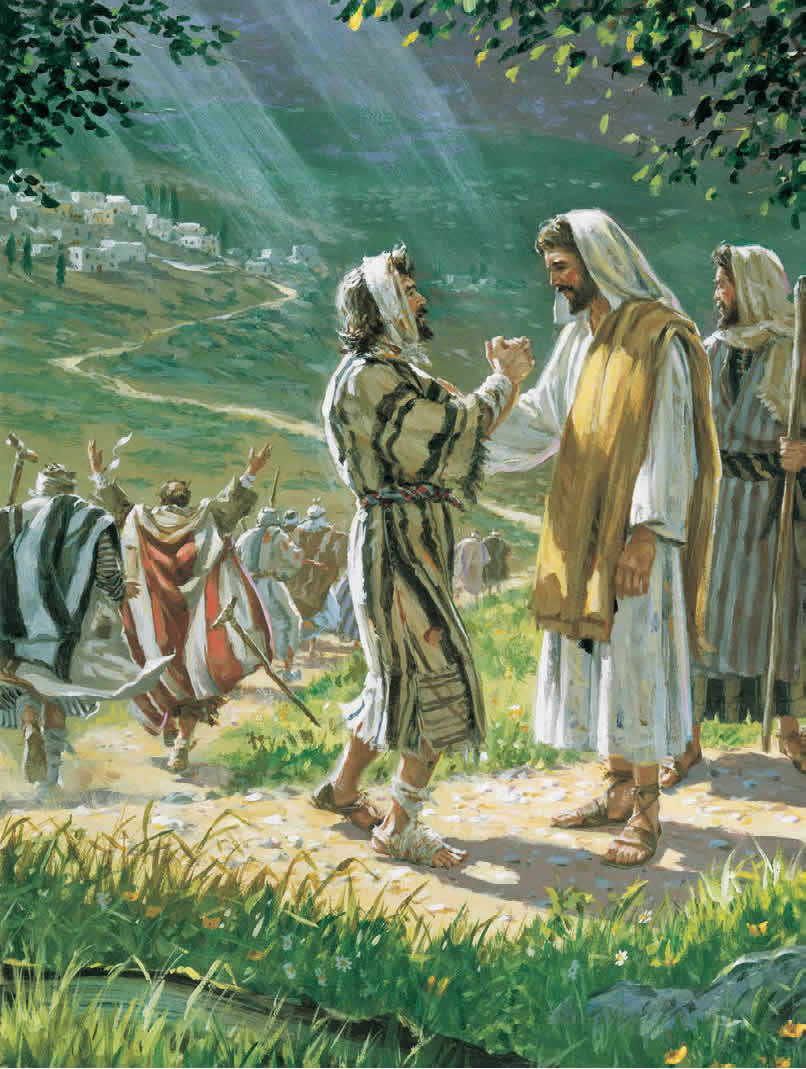
The author of Luke’s Gospel has Jesus’ healing ten lepers. It’s a story that always causes such consternation. Ten were healed but only one returned to say “thank you.”

It is good to give thanks.

But to concentrate on the one who returned is to miss the point. Maybe the other nine had good reasons.

Maybe one was a mother who had been kept away from her children for so long by this disease that turns you into an outcast. She was healed and she rushed right home and returned to her family.

Maybe one didn’t believe he had been cured because he didn’t do anything to deserve it. He couldn’t face unconditional love – healing without a price – so he couldn’t see he was healed and just went back to the colony.

Another was really, really excited about being free from the ravages of his illness and in his excitement, he just forgot.

Maybe another was alone, having already lost his family and now the only family he knew – the other lepers – were gone too. He was cured but now he was alone. He wasn’t grateful, he was ticked.

I could go on but you get the point.

Ten were healed and only one said “thank you.”

To concentrate on the one is to miss the point. Then again, I sometimes think we’ve institutionalized missing the point.

Ten were healed.

Ten were healed.

Ten cried out for mercy. Ten longed to be near Jesus so they just shouted as loud as they could. And Jesus, never one to leave someone wanting, responded simply, “Go, show yourselves to the priest” (the priest being the only one who could verify that they had in fact be healed).

They asked for Jesus’ mercy and received so much more.

Ten were healed. One said thank you.

It is good to say thank you.

But something tells me it is better to be healed.


artwork The Ten Lepers by John Steel

The Ditch

I’ve been thinking all weekend about Sunday’s Gospel reading. It is one of my favorite parables and I used to love when it would come up in class when I was teaching. But as I reflect on the events of the last year or so, the parable has taken on new meaning for me as I wonder how that scenario would play out in today’s world.

Someone would probably have video taped the attack on the man as he traveled down the dangerous road and then they would have posted it online. Every talk show would be checking in with experts to discuss why the priest and the Levite did not stop to help the man in the ditch and how much culpability they shared in the man’s plight. The Samaritan would be hailed as a hero and his story would be made into a movie.

But others would ask: “Why couldn’t the man just get up on his own?” “Why do the priest and Levite get a pass?” “Why does the Samaritan get honored for doing what he ought to do?”

They would ask those question because they have never been in a ditch.

The reality is the man couldn’t get up. I imagine it might have been because of the beating he experienced at the hands of the robbers. But most people know it isn’t always a physical reason that lands you in a ditch. Once in a great while you experience something so powerful and painful that you simply cannot help yourself. Call it depression. Call it addiction. Call it a crisis. Call it whatever you want. It’s an abyss, a darkness, and it can envelop you.

How we respond to those in the ditch says an awful lot about where we are in our own journey. It says a lot about who we are as children of God.

The truth is we are always on a journey. We are, by our nature, unfinished. By the grace of God, we are always longing for more. We must be patient. With ourselves. With each other. We must, in the words of Teilhard de Chardin, “trust in the slow work of God.”

But being unfinished is not an excuse to ignore the need around us. Longing for more does not give us permission to pass by on the other side of the road.

Who around you sits in darkness this week? Who around needs a hand? Who among you lies helpless in a ditch?

And what do you plan to do about it?


Artwork: “The Good Samaritan” by Paula Modersohn-Becker, 1907.