Rwanda

Thirty years ago this month, the people of Rwanda experienced a tragedy my western American mind could not fathom. Over the course of ninety days or so, members of the Tutsi minority ethnic group, as well as some moderate Hutus, were killed by armed Hutu militias. Neighbors killed neighbors. Family members turned on other members of their family. Even ministers, gathering their flock into the Church, betrayed the faithful and saved themselves.

By the time it was over, nearly a million people were dead. Most of the world, including the US, just watched.

Because justice was such a slow process – and in an attempt to heal the communities – the Gacaca courts were established. These trials, to put it simply, allowed those who were willing to admit their part in the killings a chance for early release. There were conditions: if they showed where bodies were buried, and if the communities were willing to take them back, people who had participated in the atrocities could be released from jail to return home. Nearly two million trials were held and though the system was plagued with problems, nearly a million people were released.

Ten years after the genocide and eight years before the Gacaca courts were shut down, I was in Rwanda with a small group from Catholic Relief Services. We were there to witness, among other things, what micro-finance programs had done to reestablish small businesses, restore dignity to the people – especially women – in the years after the genocide. We were also there to pray with the people, visit the mass graves, and talk about what the country had been through. It was then, and likely will always be, one of the great honors of my life. It was also deeply disturbing.

After several days in the city of Kigali, the group was split up and my friend, Anthony, and I traveled to the far western part of the country to the Diocese of Cyangugu. There, we visited parishes, prayed with the residence, played soccer with the students, and visited refugee camps (the people fleeing Congo). Mostly, we listened to their stories.

It has been twenty years since our visit, but several conversations remain in my mind as though they occurred yesterday. On one particular morning, we were sitting with less than a dozen people, listening to their stories of the days of the genocide. We heard how people hid from neighbors. They spoke about never finding the bodies of loved ones. They spoke of darkness, fear, and what it was like to run for your life.

Then, unexpectedly, one man introduced himself and said he had participated in the genocide. He had killed many people. He had been jailed. Then, through the Gacaca courts, he had admitted to what he had done, revealed the mass grave to his town, and been freed – welcomed home, returned to his family, and was now sitting across from me.

I think my shock surprised them. My limited capacity to love could not comprehend how this person was free. He had killed people. We had been to that mass grave. I vaguely remember saying something, more to myself than anyone in the room, “How does that happen?”

The elderly woman sitting next to me took my hand. I can still feel her small, wrinkled fingers on top of mine. Through our interpreter she explained.

“If we do not forgive, hatred wins.”

That was it. That was her explanation. For her, it was just that simple. Either you forgive or you rot inside. Suddenly, the loss I had experienced in my own life – losing grandparents, a brother, friends – my own struggles in life – all rearranged in my head. My loss was nothing compared to theirs. My life was easy compared to theirs. My whole world needed a reboot. All these years, I had believed forgiveness was something you gave to others, but this woman, still holding my hand, reminded me that, often, forgiveness is something you give yourself.

The alternative is you can let hatred win. You can let yourself be eaten from the inside out with the anger, disillusionment, frustration, and lament. At the cross, Jesus loves hatred to death. His “yes” to God gives hatred a space to die. This man who is not owed forgiveness, forgives others. He sees what is happening around him and knows the world needs saving. He knows, at his core, if we do not forgive, hatred wins.

I think about the people of Rwanda all the time. I am still challenged by the words of that old lady and I am still struggling to forgive as she had, as her community had. But each day, I feel like I get a little bit closer.

This week, let us strive to forgive those little things around us. May our perspective be rearranged so we understand injuries as inconveniences and people who irritate us as opportunities to love other people more sincerely.

Most of all, may we love the hatred around us to death so that new life can begin again.

Vacation

The folks at Merriam-Webster define vacation as follows:

va·ca·tion

/vāˈkāSH(ə)n,vəˈkāSH(ə)n/

Noun

  1. an extended period of leisure and recreation, especially one spent away from home or in traveling.

In reality, it’s when you pick up your chaos at home, pack it in a car, sit in traffic for a while, and then unpack at your temporary destination. Then, after much effort to find a sunny place to spend your vacation, you drag your stuff to the beach and create shade.

In our case, the temporary destination is Baby Condo, my aunt’s place on the Jersey Shore. It’s small – only one bedroom – but it is right on the ocean and it is free, so it is ideal. After the three-hour journey turned into six, mostly thanks to construction in New York and the clogged Garden State Parkway, we arrived in time to have lunch with Aunt B and then settle in. We’ve already hit the beach a few times and have the redness in our fair Irish skin (yes, we used sunscreen) to prove it.

Today we might hit the boardwalk in Atlantic City, or we might play games, or we go back to the beach, but in true vacation mode, it does not matter. There is no plan. We are reading, playing cards, cooking together, and yes, on occasion, irritating each other with our closeness.

The best part for me – other than just being together – will come tomorrow morning around 4:20 am. That’s when the moon sets and we will be able to enjoy about an hour of the Perseid Meteor shower – an annual sky show viewed best away from city lights. The nearly full moon will hinder the show a bit this year, which is why we will need to rise early to get a glimpse of the sky while it is at its darkest. I did a dry run this morning and enjoyed a half dozen or so meteors when the hardness of the bed woke me around 4 am.

Then Wednesday night, following the vigil Mass of the Feast of the Assumption, the local pastor will hop in a boat and bless the waters of the Atlantic. The entire congregation walks with him to the shore and participates in the blessing. The kids love it and I love watching them enjoy the rituals of our faith.

Until next week…get some rest, enjoy your family, and unplug from the busyness of life.

Capernaum

I am in the Holy Land this week with a group of young adults. We have visited Nazareth and arrived today in Bethlehem. Our visit today to the house of St. Peter and the seaside town of Capernaum reminded me of the card in my wallet.

This card in my wallet tells a story and it started, like all good stories do, with a teacher who made a difference.

It was my junior year in high school and Sr. Judy Eby, RSM asked us to reflect on that great passage from the Gospel according to St. Luke.  You remember the story: Jesus is teaching at the house of Peter in Capernaum and some friends want to get their buddy, who is paralyzed and has spent the better part of his life flat on a mat, closer to Jesus. Unable to get through the crowd, they drag the poor fellow up a ladder and down through the roof.

Then, after we read the passage, we watched a scene of Franco Zeffirelli’s 1977 masterpiece, Jesus of Nazareth. The story unfolds just like it does in Luke’s Gospel: the crowds have gathered and there is no room for the men to bring their friend to Jesus. He cannot walk, so they carry him over the wall, through the thatched roof, and place him before the Teacher.

You know what happens next. The movie takes some editorial license, but after a brief conversation, the man is told his sins are forgiven. The movie version, while riveting, fails to follow Luke’s account. Jesus forgives the man’s sins because he is moved by the actions of the friends. But more on that later.

In both versions, the crowd goes nuts. “Only God can forgive sins,” they reproach Jesus. Putting yourself on the same plane as God is only going to cause trouble. To this, we get a classic Jesus response: “Which is easier, to say, ‘Your sins are forgiven,’ or to say, ‘Rise and walk’?”

Think about that. Surely forgiving sins is easier. Right? To show the crowd what he’s really capable of, Jesus tells the man to get up, pick up his mat, and go home. The man obliges. The crowd goes nuts for an entirely different reason and everyone learns an important lesson.

But back to the card in my wallet.

We wrap up the reading, the watching, and the discussion about the friends who carried the stretcher, and Sr. Judy hands us all an index card. “Now,” she tells us, “write down the names of those who carry you to Christ.”

Wait. What? This just got real.

I have repeated that exercise with youth and adults alike for years.  I even used it last night with my group here. Like Sr. Judy, I challenged them to think of those who, when we are paralyzed with fear, sinfulness, and selfishness, carry us to Christ. When you cannot move, who lifts you up? When you are sick or alone or unhappy or in serious need of a friend, who do you call?

I have edited my list throughout the years. Friends come and go. People die. But my list has been there since that spring day in 1987. I have moved it from wallet to wallet. It’s a thirty-two-year-old ratty piece of paper that I carry with me everywhere. On more than one occasion, the list has saved my life, my soul, my sanity.

Yes, there is a card in my wallet that tells a story. It tells a story of salvation.

Who’s on your list?

Death at the Cemetery

I returned from a week in Bethlehem, Galilee, Nazareth, and Jerusalem on Saturday night and will be processing the journey for some time. It was a powerful trip, especially because I participated with twenty young adults and our bishop. Reading the Scriptural passages, studying them, and then visiting the physical places is a powerful way to make your way through the Holy Land and, as with any pilgrimage, some moments stand out more than others. There will be time, in the coming weeks, to share more of what we experienced. For me, though, it was the unexpected moments that were the most emotional.

On Tuesday, as we hiked up the hill towards the Chapel of the Milk Grotto in the West Bank of the Palestinian Territories, we noticed a large group of women coming down the hill. They were all in black and heading into a church. Not being familiar with our destination, I assumed they were heading the same place we were going. But then, many paces behind them, came the men. The first one was carrying a lid to a coffin and it became clear pretty quickly what was going on. The men were carrying the body of an old man, laid out in a coffin and surrounded by flowers. Then came another group of women, many sobbing. We stood silently on the side of a very small road, trying to push ourselves aside for the procession to pass. As they headed into the Coptic Orthodox Church, I found myself praying for the deceased and his family. It was a stark reminder that life falls over into death, even in the holiest of sites.

The following day, we were outside the Eastern Wall of Jerusalem, which faces the Mount of Olives and the Kidron Valley. On one side of the hill is an enormous Jewish cemetery. On the other side, nearest the Eastern Wall, is a Muslim cemetery. Both are hundreds of years old and yet still in use. We saw one family gathered at the grave in the Jewish cemetery, placing stones on the grave of their loved one, presumably marking a birthday or anniversary. We made our way down the hill from the Garden of Gethsemane and wandered through the Muslim cemetery so we could more closely touch the Eastern Walls surrounding Jerusalem, which have stood since the time of Jesus. As Fr. Paul, our guide, was speaking, a group of men walked in haste towards us. “Stay where you are,” Fr. Paul whispered into our headphones. As the group came closer, I could see that the man in the front of the crowd was carrying a body.

It was child.

No box. No coffin. Just a father carrying his child, presumably wrapped in the traditional white linens, though we could only see the green blanket wrapped around the outside. If I had to guess, I would say the child was no more than five or six years old. The pained look on the man’s expression was one of emptiness, unimaginable grief, and yet a look of purpose. The tradition is to bury the dead within a day, but not after sundown. It was obvious this was a recent death and so the group moved with precision, past the onlookers, and towards the grave.

I stood and wondered. Was it a boy? A girl? Had he been sick? Was it an accident? Why the hurry? These questions haunted me all day and into the night, as the rest of the pilgrims shared their reactions, prayers, questions, and thoughts as we gathered for our regular time of sharing that night. As I went to bed, I prayed for the family of that child, the repose of the soul of that child, and fell asleep thinking about my own children six thousand miles away.

Then, around 4 am, I woke up with a start. I don’t know what made me wake up, but as I sat up in bed, a thought occurred to me. Maybe the father was hurrying because he had other children at home. He had a wife he was anxious to get home to. He had responsibilities waiting. Outside the cemetery, life was waiting. It was a strange experience in so many ways.

In the United States, we have sanitized death, commercialized it even. We have rituals, a timeline, showrooms for caskets, and budgets. There is a beauty in all of this, to be sure. There is also a beauty in hastily taking the dead to their resting place, giving him or her back to God, and getting back to life. Even after leaving the cemetery, that father will carry the child with him forever. That’s how fatherhood works.

I know, too, that I will carry the image of that scene with me for some time. It is an image not on my camera, but embedded in my mind. I will continue to pray for that child, those men, that family. Religious views may divide us, but that man and I are fathers and I pray with all my heart, I never feel his pain.

May your week be filled with holy sights.

Consequences

I have had a great blessing these past few days to be walking in the footsteps of our Lord.  From the Church of the Nativity to the  waters of the Jordan to the wedding feast at Cana,  The young adults on pilgrimage, Bishop Caggiano, and I have had the great privilege of reflecting on Scriptures and then visiting these holy sites.

In our reflections last night, after praying at the Church of the Annunciation, the group discussed the consequences of saying yes. Yes to pilgrimage. Yes God. Yes to Jesus. Yes to the stirrings of the Holy Spirit in our daily lives.

Each and every day, the choice is made. Each and every moment, we find ourselves challenged to do what is right, what is holy, what is good.  There is indeed a consequence of being a follower of Jesus of Nazareth.

As Mary tells the servants in the Gospel story, “Do whatever He tells you.”

Accepting the invitation to discipleship changes everything.

What is Jesus asking of you this week?

-pjd

V+J

The other night, Maureen and I attended a dinner where the emcee asked the audience to name the last five actors who won an Oscar, or the last five Heisman Trophy winners, or the last five winners of the Nobel Prize. The room was quiet. Then he asked us to remember the names of five teachers who made a difference in our lives. Nodding heads all around.

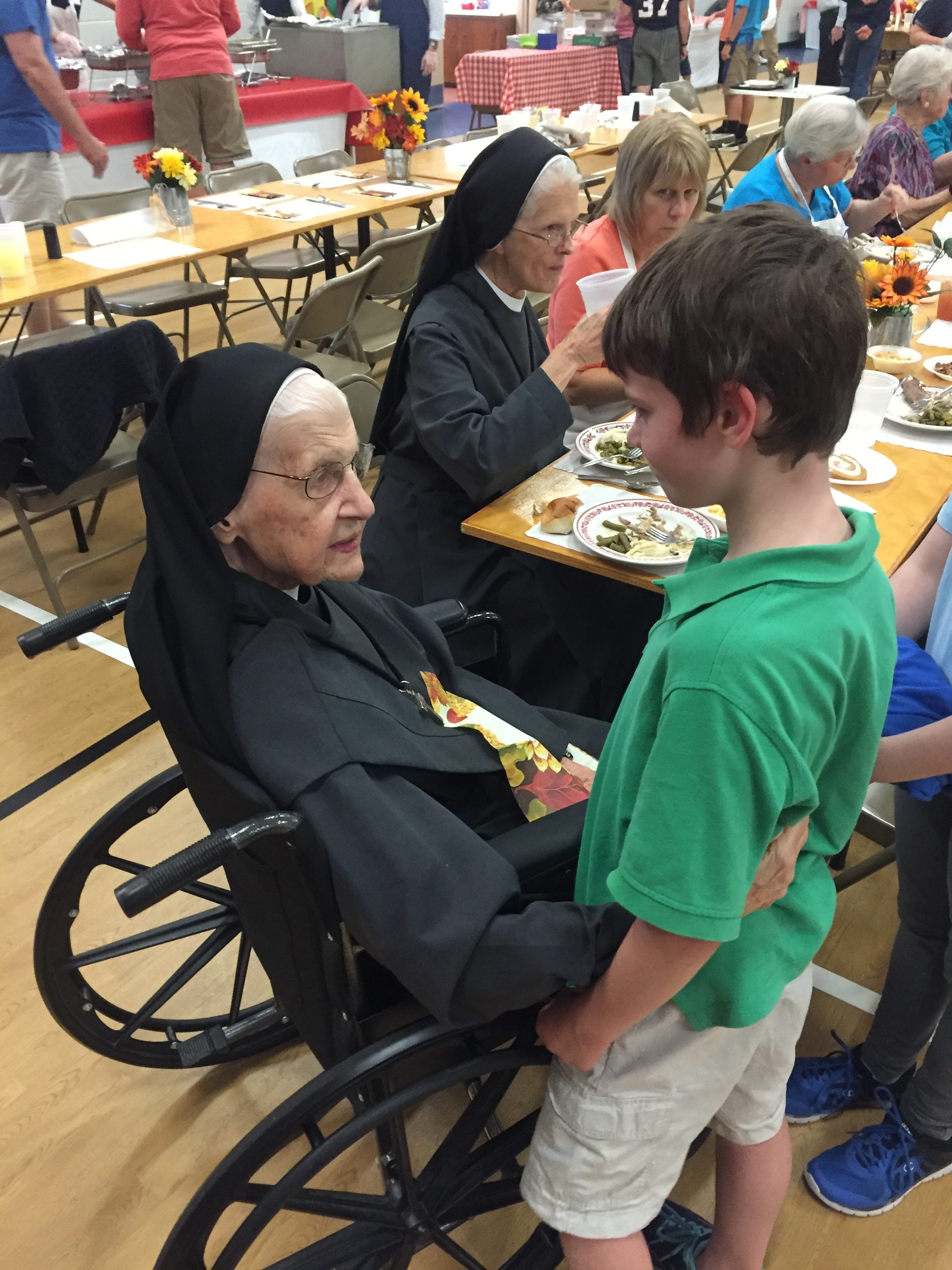
I thought of that challenge as we headed to Maryland yesterday to attend the roast beef dinner at the children’s former school. True, it is a long way to drive to take the family out to dinner, but well worth it when we saw how their friends reacted at seeing them for the first time since June.

The Oblate Sisters of St. Francis de Sales (and the food they cook) was enough of a reason to drive the four hours or so for the event. These remarkable women understand that a teacher cannot give what he or she does not have and their ability to “Live Jesus” always overwhelms me. Seeing the children interact with them, catching the Sisters up on their new school and new friends and new home, was a joy-filled sight.

We were planning to head back to Connecticut last night but since we have family in Philadelphia, we are taking the day to see Aunt Barbara. Plus, we are hoping the children’s former dentist might be able to fit child number two into his schedule, as she took a tumble down the stairs this weekend and chipped her front (adult) tooth. Never a dull moment.

Then it’s back up Interstate 95 to donate more money to the toll collectors ($1200+ since February) and finally home to the Nutmeg state.

As we drive, we will finish homework and wrap up the second Harry Potter audiobook. We will talk about last night and our former teachers and friends from another school. Most importantly, we will pray for the good Sisters, who continue to feed us – physically and spiritually – with their kindness and friendship.

May you be as blessed with such teachers in your life.