Born Blind

In Sunday’s Gospel, we hear the story of the man born blind. He finds Jesus and is healed.

It would be easy to think of this man in light of all those we know who are also blind: those who only see color when they look at others, those who only see religious practices that differ from their own, those who fail to see others in need, in pain, in darkness.

But for whatever reason, the Gospel made me think of all the things I still do not see. Though these things are ever present, I am blind. Though there are those around me who are light, I still somehow remain in darkness.

This week, I will wash my eyes and pray for sight.

To see the child whose needs are greater than my own.

To see and hear the coworker who just wants to talk.

To see the friend who has advice to share.

To see the spouse who is tired.

To see the person in need at the corner.

To see the reflection of Christ in the mirror.

To see the leader who knows more than I do.

To see the opportunities for new life around me.

Master, I want to see.

O God of Light, wash away the darkness.

That’s The Deal

Matthew’s account of the Transfiguration yesterday gives us the opportunity in Lent to take a break from all the penitence and sacrificing to celebrate what is possible. Jesus is transfigured – glorified – before the eyes of a few of his followers who share the account so all may be reminded of what is possible for everyone.

God became man so that man could taste divinity. Jesus is transfigured before a few to show the possibilities for all of us. That’s why Peter wants to build tents, remember the moment, memorialize the wonder and awe of the occasion. We all want to do that, don’t we? We don’t want the happiness of a moment to end. We want to stay in those experiences of bliss, unexpected and overwhelming joy. It’s why we build snowmen, take pictures on the roller coasters, and keep journals. I imagine if Peter, Andrew, or John had had a cell phone, we’d be remembering the moment by looking a selfie with the transfigured Jesus. But if we stay on the mountain, we only get half the story. Sure, it’s a great story – filled with wonderful feelings and ecstatic joy. But the picture is incomplete.

The joy on the mountain is but a moment. As C.S. Lewis so wonderfully reminds us, “The pain I feel now is part of the happiness I had before. That’s the deal.” We celebrate the Transfiguration in the midst of Lent because the joy the Apostles feel on that mountain is part of the agony they will experience, albeit unbeknownst to them, at the crucifixion. One will deny, another will abandon. But in time, they will come to see that it is all connected.

We build snowmen and take pictures because life goes on. Moments pass. Snow melts. We suffer tragedy and we agonize through experiences and all of these are wrapped up together in this fragile journey we call life. I am not being fatalistic or alarmist. It’s just how it is.

So pause this week and celebrate the joy, the stillness of snow or the beginning of springtime. Celebrate the wonder. Pray for the suffering. Smile at the stranger. Welcome the guest. It’s all connected – our happiness and sorrow, our pain and joy.

The happiness now is part of the pain then. The pain now is part of a happiness we cannot even imagine.

That’s the deal.

Unbelief

In today’s Gospel we see a man who hurts for his suffering child. “Help my unbelief,” he calls out to Jesus. I have been thinking about that line these past few days.

I can’t believe the things that pass for news. I can’t believe the people that pass for leaders. I can’t believe the same people who proclaim that life begins at conception also say that guns belong in schools.

I can’t believe that people really think the world is flat or that all undocumented workers are criminals, or that refugees arrive without years of vetting. I can’t believe Twitter is a thing.

I can’t believe how big my children are getting and how much fun they are when they play together. I can’t believe how often we say we are people of justice and mercy but behave quite differently. And yet, I can’t believe the recreational outrage to which so many people subscribe is quickly become the norm for our news and our politics and our communities. I can’t believe it’s almost Lent.

I can’t believe there are people who look at the wonder of creation and doubt the existence of God. I can’t believe that there are people who love God but don’t love their neighbor. And I can’t believe that there isn’t a scientist in this world who can’t come up with a rational reason that convinces us all that ice cream is, in fact, good for us.

As people of faith, there will always be things we struggle to believe. That God is love and that we, in turn, are called to share that love with others, shouldn’t be a struggle.

Help our unbelief, O Lord.

God Saw How Good It Was

It is a dad-only week as mom travels to Pittsburg for her organization’s annual meeting. I have caught up on laundry, mostly because Maureen did nearly all of it before she left. I have tried a new recipe for slow-cooker oatmeal, which the children voted “not as good” as the last recipe. And I let them have garbage for dinner one night while we watched the documentary, Planet Earth (and no, the irony of mankind’s treatment of the earth and the effect of dinner on their bodies wasn’t lost on the eldest).

It is only day three.

But there was moment in Mass yesterday when I was listening to Father John read about salt and light, that I began to think about how my children are lights in the world. The oldest is fascinated with the possibility of alternate universes and wants to study quantum physics. I’m not sure I could spell the word “quantum” at eleven.

Child number two wants to be a teacher. I have never met a child who could turn anything into “playing school.” If she helps her sister study, there is an imaginary classroom involved. If they are playing with Legos, she’s building a school. I’m not sure if she wants to impart wisdom or just likes being bossy.

Child number three will illustrate the next great graphic novel. He has taken a cue from his eldest sister and fills sketchbook after sketchbook with illustrations. When he isn’t drawing, he is casting spells from Harry Potter on all of us. I think he wishes the school would add Parseltongue to their foreign language choices.

Then there is the youngest. We are hoping the upcoming celebration of Reconciliation curbs her ability to lie to your face (“You were gone for thirty seconds and I’m not deaf, so there is no way in the world you brushed your teeth!”). Still, her gymnastic abilities are amazing. Her confidence is overwhelming. The lying will pass, I am sure, but I pray the playfulness never leaves here.

I look at these four amazing children and pray their father doesn’t screw things up. I pray that they will grow to cherish their relationships with each other. I pray that they will change the world in powerful, pervasive ways. I look from my chair to the four of them sitting on the couch, eating Chex mix and popcorn (we were out of ice cream) and I realize they are the light of the world. They are the light of my world.

And it is very good indeed.

Whatsoever You Do

“Give me your tired, your poor / Your huddled masses yearning to breathe free.”

These lines, taken by Emma Lazarus’ poem “The New Colossus,” have been in the news of late as politicians and pundits quote the lines in response to the president’s latest executive order.

But if you know your history, you know that The Statue of Liberty, which arrived in New York in 1885 and was officially unveiled in 1886, was not very popular at first. No one likes it when a gift ends up costing money. Lazarus is credited as being among the first to really understand the significance of Lady Liberty. Still, her poem did not become famous until years later. In 1901 a friend rediscovered her words and in 1903 the last lines of the poem were engraved on a plaque and placed on the pedestal of the Statue of Liberty. Lady Liberty does not hold those words in her hand, as some on Twitter would have you believe. Someone who was paying attention had to place them where they live today.

If you want to quote something that underscores the fecklessness of the executive order, go back to another text, written hundreds of years before.

“Amen, I say to you, what you did not do for one of these least ones, you did not do for me.” (Matthew 25:45).

I imagine that passage was not met with overwhelming popularity when it was first announced. Be nice to my enemy? Are you kidding? Open my door to the hungry, the homeless, the refugee? The ones who smell? Are you serious? They are so different than me. Welcome the stranger? But what if they hurt me? Shouldn’t I first test them to see what their intentions are, have them fill out paperwork, wait in line for years, and then help them? Wouldn’t that be safer?

I would imagine the best way to turn someone against you, to foster their supposed hate for you is to slam in the door in their face and tell them they are not welcome.

We have been preaching the Gospel of Matthew for a few thousand years.

The time has come to show our brothers and sisters in need whether we really believe what we preach. As the great Fulton Sheen reminded his pupils, “If you do not live what you believe, you will end up believing what you live.”

God is love. That is not an alternate fact. It is Truth. Those of us who say we believe in God should remember that.

Mary On My Mind

On this feast of Our Lady of Guadalupe, I have Mary on my mind.

I am reminded of my father and the many, many days we prayed the Rosary on the way to school. I remember coming home from school to find his car in the driveway – an oddity for so early in the day – and being told of a death in the family and then sitting in the living room reciting my father’s favorite prayer. I remember praying the Rosary every afternoon at the Grotto at Notre Dame. I remember talking with dad about new Mysteries of the Rosary he wanted to make up because he had run out of prayers. I remember dividing up the decades of the Rosary at dad’s wake among all the siblings and my older brother forgetting the words.

I remember Mary.

So on this day, I offer one of my favorite poems by Ruth Mary Fox, which is based on the alternative Gospel reading for today. May we be more like Mary, carrying Christ on life’s busy, crowded highways.

Into the hillside country Mary went

Carrying Christ.

And all along the road the Christ she carried

Generously bestowed His grace on those she met.


But she had not meant to tell she carried Christ

She was content to hide His love for her.

But about her glowed such joy that into stony hearts

Love flowed

And even to the unborn John, Christ’s love was sent.


Christ, in the sacrament of love each day, dwells in my soul

A little space.

So as I walk life’s crowded highways

Jostling men who seldom think of God

To these, I pray, that I may carry Christ

For it may be

Some may not know of him

Except through me.

Liar, Liar, Pants on Fire

Thirty seven percent of all statistics are made up.

Believe me?

You shouldn’t. I made that up.

I read an article this weekend about the rise of fake news sites. It seems that in this age of social media, more and more people are simply making up the news and spreading it around. Case in point, one of the characters in the election year tragedy playing out in our country tweeted something this weekend as news. Two hundred and fifty thousand people retweeted it (forwarded the message) or hit the “like” button to show their support.

The problem? The original tweet had no basis in fact. The candidate had simply made it up.

To be fair, both sides use social media to highlight their competitor’s faults and oversell their own version of truth. That’s politics.

But in this hyperpartisan age of campaigning, we would all be wise to do our research before believing what we read or before passing something on.

I suppose turning off the television and ignoring the whole thing is another option.

Then again, maybe history can teach us.

Two thousand years ago, a weary band of men and women met a man who changed their world. His message was love over hate, forgiveness over revenge, mercy over murder, light over darkness, justice over expediency.

No social media. No Twitter. No Facebook. No Instagram. Just the power of a positive message.

Maybe therein lies the lesson. Seek the Truth where it may be found. Spread the news that renews. Live in a way that shows others we recognize God’s presence so that in our touch, our words, our actions, God may touch, and speak, and act.

Then, perhaps, others may sense God’s presence when we pass by and, seeing us, know with little effort, they catch a glimpse of God.

No online presence is necessary.

Come Holy Spirit, renew the face of the Earth…


Artwork source: http://hoshanarabbah.org


St. Paul and the Election Season

A reading from the letter of St. Paul to the Ephesians

Brothers and sisters:

That means everyone. All of us. No one is excluded.

Be kind to one another, compassionate,

No name calling.

forgiving one another as God has forgiven you in Christ.

Help us, Lord, to understand and forgive – or simply to forgive – to comfort the sorrowful and heal the scars of division.

 Be imitators of God, as beloved children, and live in love,

That doesn’t say, “act like children,” it says imitate God like children do, free of animosity and hatred.

as Christ loved us and handed himself over for us as a sacrificial offering to God for a fragrant aroma.

We may have to suffer for a bit, but offer the suffering up for the needs of others who have less than you, suffer more than you, are more forgotten than you.

Immorality or any impurity or greed must not even be mentioned among you, as is fitting among holy ones,

This may require us to turn off the television.

no obscenity or silly or suggestive talk, which is out of place,

In public or in private. In verbal or electronic form.

but instead, thanksgiving.

You are an ambassador of others. Your needs are secondary. You are running for an office that serves, not saves.

Be sure of this, that no immoral or impure or greedy person,

Oh, Lord give us strength.

that is, an idolater,

Help me form my conscious sincerely.

has any inheritance in the Kingdom of Christ and of God.

Give me courage discern the essential from the merely desirable, the good from the less good, the less good from the bad.

Let no one deceive you with empty arguments,

But doesn’t that cover most of the arguments I hear.

for because of these things the wrath of God is coming upon the disobedient.

God will sort it out in the end.

So do not be associated with them.

Help me reflect the Light, oh Lord.

For you were once darkness,

Sometimes it feels that I still am.

but now you are light in the Lord.

Thank you, Jesus.

Live as children of light.

And invite others to do the same.

Plans

So as I look at the week ahead and review my to do lists, what we will cook for dinner, what still needs to be done around the house, and what will occupy my time at work and at home, I look to this morning’s Gospel for direction.

And, as usual, Luke interrupts my thoughts with a challenge. We have all been the man in the story from this morning’s Gospel reading. He has a wonderful harvest and makes plans to build bigger barns. But then something comes along and ruins those plans – or in his case, his own death gets in the way of the new barns he wanted to build.

In the story, the man is chastised not because he plans but because his plans do not include God. “Here is what I will do…I shall tear down…I shall build… I shall store…then I shall say to myself…”

He keeps his wealth instead of sharing it. He plans to take care of himself and forgets those in need around him. He looks out for number one and avoids eye contact with the man or woman standing next to him, those standing on the corner, those sitting across from him or suffering across the world.

It’s a story to which we can all relate.

But, as the poet reminds us, “No man is an island…”

So I go back over my schedule for the week. When is time for prayer? When will I make sure I am present to others? When will I go out of my way to share the harvest, limited though it may be at times, with others?

Planning is good. Plans that include God are better.


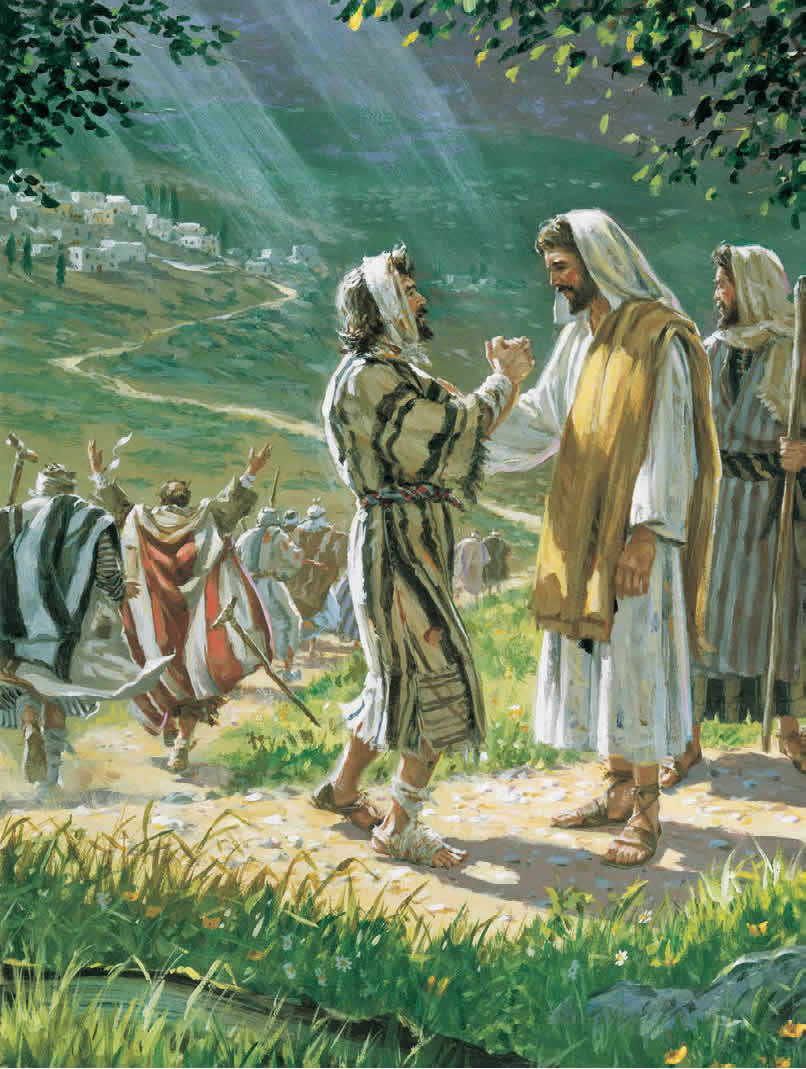
Healed

After last night’s televised freak show, I am tempted to reflect on the demise of American democracy, but thankfully, I am distracted by the story in Sunday’s Gospel.

The author of Luke’s Gospel has Jesus’ healing ten lepers. It’s a story that always causes such consternation. Ten were healed but only one returned to say “thank you.”

It is good to give thanks.

But to concentrate on the one who returned is to miss the point. Maybe the other nine had good reasons.

Maybe one was a mother who had been kept away from her children for so long by this disease that turns you into an outcast. She was healed and she rushed right home and returned to her family.

Maybe one didn’t believe he had been cured because he didn’t do anything to deserve it. He couldn’t face unconditional love – healing without a price – so he couldn’t see he was healed and just went back to the colony.

Another was really, really excited about being free from the ravages of his illness and in his excitement, he just forgot.

Maybe another was alone, having already lost his family and now the only family he knew – the other lepers – were gone too. He was cured but now he was alone. He wasn’t grateful, he was ticked.

I could go on but you get the point.

Ten were healed and only one said “thank you.”

To concentrate on the one is to miss the point. Then again, I sometimes think we’ve institutionalized missing the point.

Ten were healed.

Ten were healed.

Ten cried out for mercy. Ten longed to be near Jesus so they just shouted as loud as they could. And Jesus, never one to leave someone wanting, responded simply, “Go, show yourselves to the priest” (the priest being the only one who could verify that they had in fact be healed).

They asked for Jesus’ mercy and received so much more.

Ten were healed. One said thank you.

It is good to say thank you.

But something tells me it is better to be healed.


artwork The Ten Lepers by John Steel