Memorial Day

It would easy – too easy – to lose sight of why we take the day off from work today. Between hot dogs and hamburgers, beach passes, and cutting the grass, today marks the unofficial beginning of summer. Many of us will stand along streets to watch parades, catch up on household chores, and spend time with family and friends.

But it’s important, too, to pause for a moment and remember why we enjoy the freedom to do the things we love to do. Thanks to the sacrifice of someone’s daughter or son, sister or brother, mother or father, you and I get to vote for whomever we choose and then complain about the outcome. We get to speak our mind out loud without fear of recrimination and we get to worship wherever we choose.

Freedom comes at a price. Following the Civil War, which claimed more lives than any conflict in our nation’s young history, our leaders were faced with the need for the country’s first national cemeteries. Within a few years, Americans in towns and cities began setting aside a day in late spring to pay tribute to the fallen, decorating their graves with flowers and praying for the dead.

As wars continued, so did the number of cemeteries. Decoration Day gave way to Memorial Day, which was established officially as a federal holiday in 1968 and first celebrated across the country in 1971.

So even if you do not have a chance to visit a cemetery and lay flowers at a grave, you and I can pause this day and give thanks for the brave women and men who offered, as President Lincoln called it, “the last full measure of devotion.”

And so we pray…

God of power and mercy,
you destroy war and put down earthly pride.
Banish violence from our midst and wipe away our tears,
that we may all deserve to be called your daughters and sons.
Keep in your mercy those men and women
who have died in the cause of freedom
and bring them safely
into your kingdom of justice and peace.
We ask this through Jesus Christ our Lord.
Amen

—from Catholic Household Blessings and Prayers


reprinted from May 2017 (forgive the re-post, we are taking a break today)

Come, Holy Spirit

Come, Holy Spirit…

Fill our mouths with language that is kind instead of hateful.

Fill our homes with love instead of greed.

Fill our schools with knowledge instead of guns.

Fill the halls of power with authenticity instead of dishonesty.

Fill our skies with birds instead of weapons.

And fill our world with peace.

Give our children the wisdom to see that they are loved – and lovable.

Give our parents the courage to say, “no” to that which is harmful to children.

Give our leaders the strength to speak truth to power.

Give us all the fortitude to bring peace to our workplace and homes.

Wash us clean, Holy Spirit, that we may begin again, renewed, resolving to work for what is right, what is holy, what is just, and what is good.

Most of all, Holy Spirit, open our hardened hearts to receive your Spirit. Open our closed minds to receive your wisdom. Open our mouths only to proclaim praise to the Triune God, the giver all of gifts.

Amen.

Weeping Over Jerusalem

They say that if you visit the Holy Land for a day, you can write a book. If you visit the Holy Land for a month, you can write an article. But if you visit for any longer, you can’t write anything. So complicated is the conflict and so profound the experience that trying to make sense of it as an outsider is almost impossible.

This week, this holy city will be in the news again. For years, US presidents have signed a waiver keeping the US embassy in Tel Aviv out of respect for the Palestinians and citing national security issues. Now we have a US president with his own thoughts on the matter, so today the embassy will officially move from Tel Aviv to Jerusalem, a city whose future is always a hot topic anytime you bring the Israelis and Palestinians together for peace talks.

The day of the move is intentional. Today is the seventieth anniversary of the recognition of the state of Israel. The Palestinians call it the great catastrophe. You would need to read volumes to understand it well. You would need to understand the British Mandate, the atrocities of World War II, the Arab-Israeli War from the late 1940s, and more. You would need to understand why the United Nations Partition Plan for Palestine never worked and why creating one state by forcing people from their homes to make room for people who were forced from their homes never works.

This week, there will be stories on the news about people protesting, throwing rocks, and burning flags. Then the commentator will mention in passing that several of those protesters were shot and killed. Watch the video. Listen carefully. One side will be labeled terrorists. One side will not. One side will pick up rocks because it’s all they have. The other side will load guns given to them by the US and shoot at the opposition.

It is not a fair fight.

There are reasons to be troubled, no matter your politics. We are running towards a peace process with our eyes closed. We are befriending some countries and alienating others. We are ignoring the past in hopes that we can change the future. But we do so at our own peril and at the peril of those who will grow up surrounded by barbed wire in Gaza and behind barricades in Bethlehem.

Pray for peace. Beg for peace. Spend these nine days between the Ascension and Pentecost not looking at the sky but watching the news, absorbing the story, learning what you can about the truth of the matter.

Then, when Pentecost comes, let us hope and pray that the Spirit of God washes over all of humanity, not just those with whom we agree.

Come, Holy Spirit, and renew the face of the Earth.

~pjd

Looking Up

This time of year always makes me think of the early followers of Jesus. Perhaps it is the combination of Easter, new life, springtime, and allergies. Trust me, it’s all connected in my head.

The readings for this season are all about those early days, how an experience of God-through-Jesus led people to faith. There are stories about how those experiences led to inclusion, exclusion, joy, and suffering. How persecution gives way to stronger faith and how conversion leads to a paradigm shift that gives the early church new leadership.

There was an article in the Wall Street Journal recently about the movie Paul, Apostle of Christ(which is well worth seeing). The article cited a remarkable fact: when Paul died in A.D. 67, there were 2,500 Christians. By the year 350, there were 34 million. Think about that for a second. In a time when you would be killed for professing faith in the Risen Jesus, the Good News spread, more people came to faith than left it, and the church flourished.

Then Constantine came along and institutionalized the faith into religion and things have never quite been the same. It seems we might have been better off when we had to tell the story than when we were allowed to tell the story. More on that another time.

This week, we will read about those early followers standing alone, looking at the sky, waiting for Jesus to return. They did not know when he would return, only that he had promised to return. So they stood there, staring at the sky, missing life around them.

The family continued our trek through the Marvel movies this weekend with Dr. Strange. In some ways, it was a typical superhero story: an overachieving protagonist is really a jerk at his core, arrogant and narcissistic. Then his world comes crashing down and he comes face to face with the one incontrovertible fact we all face at some point: life is not all about you. That new perspective requires a basic change in position. We no longer live for ourselves. We live for others.

The early followers figured this out. For them, it was never about gathering for Mass, making sure it only lasted an hour and then screaming at each other when one donkey cut another donkey off in the first-century parking lot. No, it was about serving others in the name of Jesus. It was telling the Jesus story. It was about the family meal where we remembered the sacrifice and sacred instruction. It was about taking care of the widows and orphans, the least among us, and caring for the basic needs in society. There was no right or left, only the Christ I see in you – and that required an action. It required selflessness. It required love.

Spoiler alert: the Jesus story still requires all those things. If only we could stop staring at the sky and get to work.

~pjd

Losing Our Way

Like many people, I use Waze to help me get from point A to point B. I call the disembodied voice Gladys and, most of the time, she is very helpful.

Last week, I was headed to a parish I had not visited before. I could see it. I knew in my gut it was a left turn ahead and not a right turn. But Gladys kept telling me to turn right, so I did. My instincts, it turned out, were correct. Gladys was wrong.

As I pulled into a driveway and turned around, it made me wonder why I listen to the voice coming from my phone more than I listen to the voice inside my own head. I thought about all this again on Thursday as the young people from my class at Sacred Heart University circled the neighborhood looking for our house. I had invited them over to watch A Man for All Seasons as we ended the semester but I finally had to send two of the children outside to flag some of them down.

You see, when the neighborhood was built, the new homes were mostly for executives from General Electric and everyone got to choose their own house numbers. I am not kidding. We live at 301 but 305 is across the street. 87 is roughly seven houses away and is next door to 228. There are not “evens on this side and odds on that side.” Nope, it’s a big hot mess. I will admit, however, that it is fun to watch the substitute UPS driver try to figure it out. Apparently, the personal assistants the students were using could not figure it out either and so the children were sent to flag them down.

In this week’s Gospel reading, Jesus tells Thomas, “I am the way and the truth and the life. No one comes to the Father except through me.” (Jn 14:6) And yet, we often give more authority to our smartphones (which are making us dumber, some would argue), or the television (real news vs. fake news), or the people around us (even if ill-informed). We live in a world where it will soon be possible to animate a real person and have that person appear to say things the person never actually said. Think about that. You could be watching television and think you are watching the Pope or the President or the leader of another country giving a speech when, in reality, the words are made up to incite others, not inform them. To echo Mark Twain, that false account will likely get around the world much faster than the truth.

Jesus is the way to God, the way to peace, the way to life eternal. No hacker or virus or false media report can make that less true. It is the Truth to which we must be converted so absolutely that it dominates our every thought, word, and deed.

This week, I will silence the voices around me – in my car, on my phone, and in my head – and listen to the Truth I learned long ago. Might I challenge you to do the same?

May your week be blessed.

-pjd

Outcasts

For the Donovan family, Friday night is movie night. It has been that way since the oldest was a baby. The children (and parents) still miss the seating and the set-up from our family theater in Delaware, but like all first world problems, we muddle through with a large screen and comfortable seating.

Several months ago, we began to watch what we thought was the next movie in the Captain America series but within a few minutes realized we had no idea what was happening. With a little research, we discovered that you are not supposed to watch the Marvel movies in order of release. They tell a story and to understand it, you have to know which movie to watch and in what order to watch them. We are about fourteen weeks into this adventure and some of the movies are just fantastic. They speak of family and sacrifice, loyalty and redemption. They are worth the time and money it takes to rent them.

This weekend, however, we added another movie to the mix as we finally sat down to watch The Greatest Showman. It is a hybrid of Hollywood and reality and tells the story of P.T. Barnum, who lived and is buried just down the road. While it skips most of his time in Bridgeport (as mayor and legislator), it does tell the story of his relationship with those most vulnerable – and detested – in society.

I was a fan of the circus until the day it closed. We used to go every year near my birthday. In those early days, the title “circus’ was given to Barnum’s gathering of oddities as a term of derision. The people he gathered (and exploited) were among those that no one wanted to be around: the bearded lady, the tattooed man, the tall man, the short man, the fat man, and the hairy man, the conjoined and the dark-skinned. These are the people, the movie tells, that Barnum befriended with a smile and who helped him put on the greatest of shows.

In typical Hollywood fashion, he forgets his roots as the poor son of a tailor. He seeks fame and acceptance among the upper class. Only when tragedy strikes is he reminded what family really means, as he is encouraged to come home and rebuild. There is crucifixion and resurrection all wrapped up with songs you will be singing all week.

But the reason I loved the movie goes beyond the song and dance, though child number two couldn’t stop singing and child number four couldn’t stop dancing. There is a scene where Barnum’s youngest child meets the bearded lady and, while everyone else is laughing, she takes a cue from her father and looks past the lady’s shame and directly into her eyes. Barnum calls the bearded lady beautiful. His daughter smiles and maintains eye contact.

It made me wonder what cues my own children would take from me. Do they look upon those whom society ignores with love or do they change lanes to avoid eye contact? Do they treat others with respect or, like the crowds in the movie, yell, “You are not wanted here; go home?”

As my children grow, will they be among those outside the tent or among those who serve and are loyal to those singing and dancing?

Children watch. They don’t always listen. But children watch.

Sometimes it frightens me to be so powerful.

-pjd

Converted

On Friday this week, we hear about the conversion of St. Paul.

I love that at the root of his faith is his experience.

His conversion experience is so powerful it becomes his whole life, his whole world. It defines his reality. The institutional church makes him a hero. In reality, he is a rebel. Paul doesn’t go along with the parameters; he sets the parameters.

He trusts his experience. It is not an “outer” authority with which he speaks, but an “inner” authority. So convinced is Paul of his conversion experience, he gives himself the title, apostle to the gentiles. Apostle: a title reserved in those early days for those who had experienced the risen Jesus.

Both Jesus and Paul trust their experience of God against the tradition. Over time, the institutional church takes the experience of both and domesticates it. There has to be a balance, I think, between trusting our “inner” authority and falling over into relativism.

There’s room for the “outer” authority, to be sure. But I don’t think we should be on bended knee before it either. I think we should behave as those who know something deep within – an experience of a God who won’t let go, no matter what.

In Galatians 2, Paul says quite clearly, “I have been crucified with Christ; yet I live, no longer I, but Christ lives in me…”

Powerful words. Such was Paul’s experience that he understood – before Matthew, Mark, Luke, or John ever told him – the death of Jesus was Paul’s own death to sin. One death for all.

So strong was the bond for Paul that it was not his words changing lives, but Christ’s. Not his actions, saving souls, but the resurrected Jesus’, now confessed as Christ.

For Paul, life became all about participation in the Body of Christ. We no longer live in the world and go to Church, rather we live as Church and go out to the world. It’s a basic change in position and it can only happen after we’ve been thrown to the ground and converted.

And what’s the opposite of participation?

Control.

Think about it. Do we participate or do we control?

I really do love St. Paul.

~pjd

Twins

Anyone who has been reading this blog for a while knows that I have an affinity for good old Thomas. I get Thomas. I knew we would hear about him this week, just like we do every year around Easter. So I was prepared.

I even talked to a friend at work about Thomas on Friday afternoon. He’s a deacon and was preparing his Sunday homily. Lucky for me, we get to talk about such things at work and so Thomas came up in the conversation. As you know, Thomas was not present when Jesus first appears to the disciples. They were locked in the upper room for fear of the Jews. Thomas simply was not there.

Did you ever stop to think why? Where was he? Doing laundry? Catching up on some sleep (Easter can be exhausting)? Visiting his family?

The truth is, we do not know. What we do know is that in John 11:16, it is Thomas who says to the others, Let us also go, that we may die with him,” as Jesus works to convince his followers that they must return to Judea. He does not hesitate, this Thomas. If suffering is what Jesus has to endure, then let us go and endure it with him. They are, the story says, on their way back because Lazarus has died. So Thomas, presumably, knows what Jesus is capable of doing.

So where is he on that “evening of the first day of the week,” while the others were locked in a room, trembling with fear.

Could it be that he was not afraid?

Could it be that, even after all that he had seen and experienced, he trusted Jesus and knew the work must continue?

Assuming I am correct and Thomas was out and about telling the Jesus-story. Why does he doubt when the others tell him that Jesus had visited?

Perhaps the answer is in his name.

Thomas is called Didymus. It’s the Greek word for Twin. But whose twin?

Could it be – is it possible – that you and I are the twins of Thomas? Could it be that the name is given to those who struggle and wonder and doubt, even though the answer is right in front of them?

Could it be that, even after all the goodness and holiness and wonder and awe we experience, we still question if Jesus is present.

“My Lord and my God.” My everything. My master. My teacher. My witness. My ruler, leader, superior, monarch, sovereign, and king.

It is the cry of one who is – and was – faithful, but just forgets now and then to really see.

~pjd

Sing Out, Earth and Skies

When you do Lent well, Easter means more.

This year, as a family, we did Lent well. We prayed together, we sacrificed, we talked about being better, and we talked about Lent. The poster created at work hung in the kitchen and, while it encouraged forty ways to live Lent well, we got to about half of them, which is pretty good, all things considered.

The kids were adamant that no one say the “A” word and chastised friends who did. We go through this every year.

The season – cold, snow, and all – seemed more real this year for some reason. Perhaps it was because we needed resurrection from a long, cold winter. Perhaps because for us, as a family, our Lent included power outages and hospitalizations, viruses and snow days. Perhaps it was last week’s funeral that tipped Lent more towards darkness than usual. Perhaps we gave up more, lived more intentionally, and waited, hoped, and prayed with greater fervor.

But come Sunday morning, the energy and enthusiasm was palpable and came not from chocolate but from the anticipation of getting the “A” word back. As we drove to church, the children, especially the youngest, wondered exactly when we could return to the singing of the “A word.”

When it was time to sing it within the context of Mass, no one missed a note.

Then, on the way home, we sang it some more.

Indeed, it is good to have the “A” word back.

We are an Easter people. A resurrection people. Alleluia. Alleluia.

Hope has transcended the bounds of death.

Death has been vanquished.

Even on the cross, overwhelmed by a prayer of abandonment by the God he has so earnestly and steadfastly served, Jesus refused to give over to resignation. He forgave.  He kept believing and hoping. He said, “yes” to God. Again and again, he said, “yes.”

Jesus has delivered himself entirely from himself in order to be completely God’s.

And so stones are rolled away. And God says, “yes” right back. God raises that which we crucify.

The tomb is empty. He has been raised. Now, go and tell the Good News.

We are an Easter people. And “Alleluia” is our song.

May your week be blessed.

~pjd

Fr. John

Fr. John Baran, our pastor, and my dear friend died on Saturday. He was only 59.

As I mentioned back in December, when I asked for you to pray with me for Fr. John, this good priest was among the first of many I met here in the Diocese of Bridgeport. When I first moved to town, people asked where I would be going to Mass. Everyone who asked recommended St. Anthony of Padua. The pastor, they said, was the best homilist in the diocese. They were right. Like you, I have heard my fair share of good homilies and, like you, there have been many Sundays where I sat and wondered, “Where in the world is he going?” That was never the case with Fr. John. You looked forward to his preaching and it carried you all week long.

I asked once how he learned to connect the readings to the lives of the faithful so well and he laughed and told the story of his homiletics professor in seminary who encouraged the class with the instructions, “Never preach longer than you are interesting.” Then, after a long pause, added, “And remember, gentleman, you are not that interesting.”

When I first met Fr. John, he welcomed me with tea and cake in his rectory. We shared stories of favorite authors, prayers that moved us, and I learned then what a great gift he was to our Church. In time, I came to experience first-hand what a great gift Fr. John was to our family. My children can quote his stories and would go to Mass as much to see Fr. John as to worship. I can quote his homily following the shootings in Orlando last year – or at least retell it – and it marks the first time in my life that a homily was followed by spontaneous and sustained applause. But that was not the only time Fr. John got such a reaction (though it was never, ever what he sought).

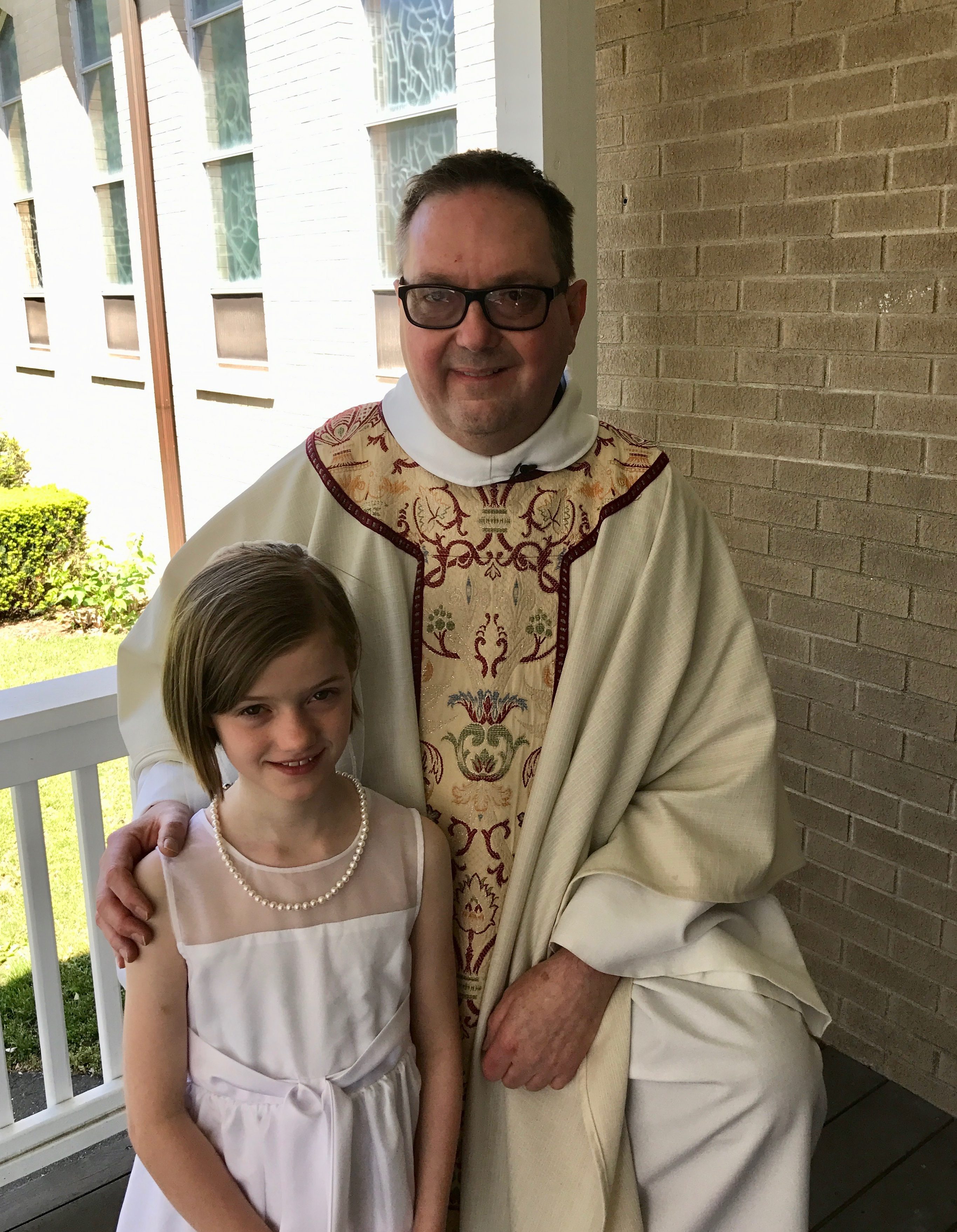
It was Fr. John who sat with me to tell the children that Maureen’s father had died. It was Fr. John who gave Katie her First Communion (and second, and third…). It was Fr. John who would take Molly aside to talk about black holes and quantum physics and then mutter to her mother and me, “What in the world is she talking about?” It was Fr. John who prayed with us, laughed with us, invited Maureen and me over for drinks, and gave out more Halloween candy than anyone (275 pieces last year) – and not those cheap little pieces, but giant, full-sized candy bars. Many, including us, would drive across town to see Fr. John, wish him well, show off the costumes, and pick up some candy.

Diagnosed with Muscular Dystrophy some time ago, Fr. John occasionally struggled to manage the steps to the altar or the walk to the rectory, but I doubt anyone ever heard him complain. When the metastatic melanoma settled in and immunotherapy began, John never whined. Instead, he longed to come back to parish life and be with his people. He would join us on special occasions, twirling around in his scooter before Mass, though you could tell the real pain came from his lack of energy to celebrate the Eucharist with us.

Fr. John was the kind of priest that every parish wants, and every diocese needs by the dozens. He welcomed everyone not because it frustrated those who were unwelcoming, but because it was, like it or not, exactly what Jesus instructed. He did not judge. He did not gloat. He recognized that we are all sinners – himself included. Plain and simple, he preached the Gospel better than anyone I have ever met. But he not only preached it. He lived it.

In the end, I am told he was unafraid. I am not surprised. He kept his sense of humor about him, though he could barely move. He made those who visited him feel at home and smiled at the thought of using his long-stiff legs once more.

Perhaps our Katie put it best. As we gathered the children to tell them, pray the Rosary, and cry together, she seemed to echo what each of us was feeling. At age nine, she is often closer to the Truth than anyone. “I can just see it now,” she said, “Fr. John running into the arms of Jesus.”

That is how I want to remember my friend. Running. Dancing. Disease-free. Pain-free. Worry-free. Running into the arms of a Lord he served so well. And I know, if we had listened carefully Saturday morning just around 7:30, we could have heard the voice of Jesus praising John.

“Well done, my good and faithful servant. Rest. Be at home. Have a drink.”

May the choirs of angels, come to greet you, Fr. John. May they speed you to paradise. May the Lord enfold you in His mercy. May you find eternal life.

~pjd